Mr. Agyei Kwame, Manager of Plantations Investment & Extension, Forest Services Division, Forestry Commission, has mentioned that Ghana is moving its Forest Plantation Strategy from policy to practice, but says the next phase will depend on foreign investment and technology partnerships to meet both timber demand and European Union Deregulation Requirements (EUDR).
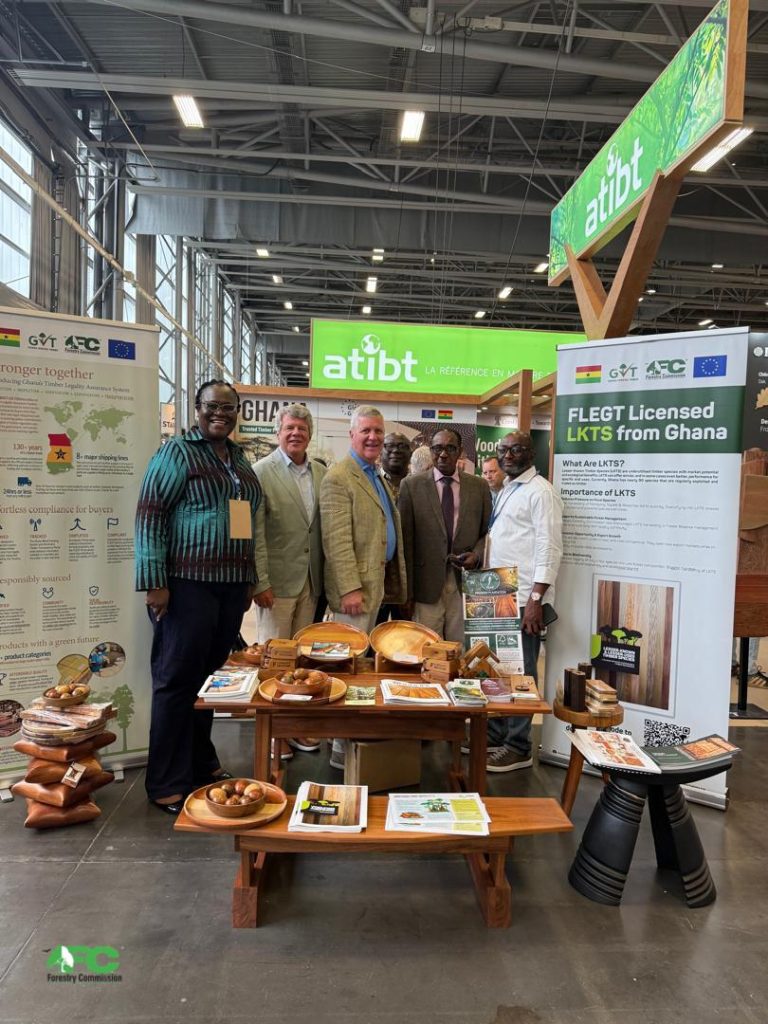
He mentioned this when he presented Ghana’s position during a panel discussion on “Potential EU Ghana Collaboration in Forest- Based Industry” at the EU-Ghana Timber Trade and Investment Forum, which was organised as part of the activities for the Carrefour International du Bois, held in Nantes, France.
Mr. Agyei briefed EU participants on where Ghana stands 10 years into its 25-year Forest Plantation Strategy 2016-2040 and mentioned that the Strategy’s core objectives are to:
- Increase national timber supply through commercial plantations to reduce pressure on natural forests
- Restore degraded forest lands and contribute to Ghana’s climate commitments
- Attract private sector and community participation through out-grower and joint-venture models
He positioned the Commission’s role as shifting from regulator to investment facilitator. This aligns with Ghana’s wider pitch at the forum — that it is now a FLEGT Licensing country since 8 Oct 2025, meaning timber from these plantations can enter the EU with 100% legal assurance.
Mr. Agyei outlined implementation challenges that Ghana is openly discussing with partners, the first of which is Investment and Finance. He mentioned that timber plantations have 15-25 year rotations and that long payback period makes them unattractive for commercial banks. He flagged the need for “patient capital” — long-term, low-cost financing that matches the crop cycle.
On seedling acquisition, Mr. Agyei said that scaling up means securing high-quality, genetically improved seedlings at volume. Inconsistent seedling supply and variable growth rates affect investor confidence and projected yields. With the EU Deforestation Regulation in force, buyers need verifiable data on origin, growth, and legality. Mr Agyei indicated that Ghana is seeking EU collaboration on Smart Forestry tools and remote sensing to ensure that digital records satisfy EUDR due diligence for FLEGT timber.
The 2016-2040 Strategy relies on community partnerships. That means clear land tenure arrangements and benefit-sharing are operational priorities for the Commission.
Mr. Kwame Agyei further outlined Ghana’s aspiration for international collaboration in two concrete ways. First, he talked about direct investment into plantation development. Models include private sector plantations, out-grower schemes with smallholders, and joint ventures. This connects directly to the forum’s objective of “promoting trade and investment in forest-based industries.”
The second one was on technology and expertise, where Ghana wants EU know-how in plantation management, yield forecasting, and digital monitoring.
Mr. Agyei concluded by saying that “We have FLEGT legality, Lesser Known Timber Species and new plantation wood coming. To deliver it reliably to the EU, we need investment and Smart Forestry tools.”
With the EU importing EUR 26m in value-added wood products from Ghana in 2024, and with natural forest supply tightening under EUDR, Mr Agyei’s message was that Ghana’s future supply security lies in these plantations.